 Boletar
Porcini Field Guide
Boletus edulis
A species described through many observations, not one visual shortcut. These are literature-based characteristics, not a verdict on anything you have found.
Educational field guidance only. Boletar does not identify mushrooms or determine edibility.
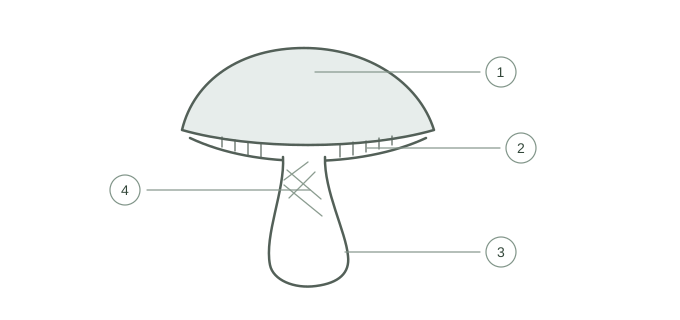
- Cap
- Pore surface
- Stipe
- Reticulum
Cap · pileus
Descriptions give pale to dark brown, yellow-brown or reddish-brown caps, smooth and greasy to the touch, often with a paler line at the margin. Record the colour in natural light and note the cap’s condition; a brown cap alone does not establish a species.
Under the cap · pores and tubes
A pore is the opening of a tube, rather than a gill. In young porcini the pores are plugged with a layer of white hyphae that breaks down as the mushroom matures. Typical B. edulis descriptions trace the pore surface from white through yellowish to olive. Kew notes that plugged pores are characteristic of porcini but not restricted to them, so this age pattern is context, not a diagnostic rule.
 (External website) Beugelsdijk et al. / Persoonia 20: 1–7 · A phylogenetic study of Boletus section Boletus in Europe (2008) · Introduction (External website) Université de Rouen Normandie / Smart Champignons · Boletus edulis · Description (External website)
Stipe · the whole stem
A substantial, often swollen stipe is commonly described, but its proportions vary. Observe its full profile where visible, rather than judging from one cropped view.
Reticulum · stem reticulation
Reticulum means a raised, net-like surface pattern. In B. edulis descriptions it is fine and mostly on the upper part of the stipe, rarely along its whole length. Kew notes that a net is not unique to porcini: a netted stem is not proof of B. edulis.
(External website) Beugelsdijk et al. / Persoonia 20: 1–7 · A phylogenetic study of Boletus section Boletus in Europe (2008) · Table 2 (External website) Université de Rouen Normandie / Smart Champignons · Boletus edulis · Description (External website)Flesh · context and colour change
Typical descriptions refer to white flesh that does not change colour when cut, sometimes pinkish just under the cap skin. Record an observed change and its timing, rather than turning an absence of blue into a rule. This characteristic alone cannot identify a mushroom.
Habitat · a partnership with trees
Ectomycorrhizal fungi associate with plant roots. B. edulis has a broad ecological range and is reported with deciduous and coniferous hosts, including spruce, oak, birch, beech and lime, and more rarely pine. Nearby vegetation is useful context, not proof of the host or species.
Variation matters
B. edulis is morphologically variable. In the European phylogenetic study, collections with different cap colours and hosts showed almost no genetic difference, and the authors concluded that such characters had been overrated for splitting B. edulis into separate taxa. The same study treats B. aereus, B. pinophilus and B. reticulatus as well-delimited species. Bring uncertainty to an expert, not to a matching score.